
Pillar 1: Get Informed
Understanding the medical words . . .
We health professionals can be guilty of tossing around their trade words like everybody understands them. Our apologies :). So let’s take a few moments to understand what the term “Osteoarthritis” actually means!
Where two bones meet in a joint, there is a covering on the ends of the bones. This covering, as you probably know, is called cartilage. In the knee, things are a bit unique. We have cartilage covering end of the femur (thigh bone), and we have a special kind of thick cartilage pad covering the tibia (shin bone).
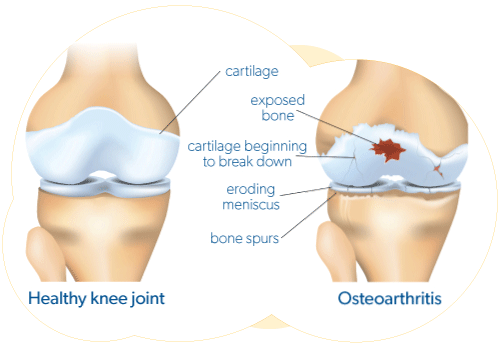
Image Credit: Sprinloaded Technologies
The thick pad on the shin bone is called a meniscus, and we have a meniscus in each ‘compartment’ of the knee (called the ‘medial’, or inside, and ‘lateral’, or outside compartments of the knee). The cartilage in the knee is a tough, elastic material, but in Knee OA, both the cartilage on the end of the femur, and the meniscus on the tibia can breakdown. This also leads to damage to the bone underneath the cartilage.
So why does osteoarthritis happen?
Well, in the joints of our body, there is a constant process of repair and replenishing these cartilage tissues. Some people’s joints repair process can keep up with what is needed and don’t have any overall breakdown. In many, however, when the repair process is not able to keep up with damage that is occurring, osteoarthritis may begin to develop.
Could I have prevented the damage in my knee?
Maybe, maybe not. Some people simply have damage to the knee because of the way they were born and the way their bones come together. For other people, they may have had joint injury such as a cartilage injury or knee ligament injury in the past that has increased the strain on their tissues over time. Some people have just been exposed to heavy workloads on their knees for a long time. For other people. excess weight can contribute to the increased load on the cartilage and this will cause an accelerated cartilage breakdown. In all of these cases, the repair process has not been able to keep up with the breakdown process.
And we might as well get the bad news out of the way. Whatever the reason for the cartilage breakdown, unfortunately at this point in mankind’s history anyway, we can not ‘fix’ the cartilage that has been damaged. Additionally, if you don’t take active steps to counteract it, your condition may get worse. Watch the video below to see a great animation of the anatomy of the knee and how OA affects it.
And we might as well get the bad news out of the way.
Whatever the reason for the cartilage breakdown, unfortunately at this point in mankind’s history anyway, we can not ‘fix’ the cartilage that has been damaged. Additionally, if you don’t take active steps to counteract it, your condition may get worse.
Watch the video to the left to see a great animation from the American Academy of Orthopaedic surgeons outlining the anatomy of the knee and how OA affects it.
But remember, this is not the end of the story!
Is there any good news?
After watching the video, you may ask yourself ‘ how can I make a knee that looks like that any better?’. Well, the strange thing is, what the knee looks like on imaging, is not always predictive of how much pain and disability you have. The strange thing we are finding out is that there are people with ‘bad’ looking x-rays that have minimal pain. We have to be careful of how much we let the ‘pictures’ influence us - the important thing is how your knee is affecting your life and how you manage the condition.
So yes, there is good news! If you are coming to this page with significant knee pain and disability, know that there is a lot of evidence that says you can significantly reduce your pain and improve what you are able to do! For many people, it is also possible to reduce your medications and even avoid surgery.
The important thing is to get started on managing your knee OA as soon as you can so slow dow the damage that is occurring. There is much you can do that doesn’t involve medications, injections, or surgery. Most of this you can do in your own home!
That’s what our 4 pillars of knee OA management are all about!