
Introduction
Before we get started, there are a couple of key concepts that this whole course is based on that would be good to cover right up front. They are Evidence-Based Treatment Guidelines and a simplified form of those guidelines, the Knee Osteoarthritis Treatment Pyramid.
Where there’s pain, there’s money -both for good and bad.
As humans, we tend to be willing to part with our cash to alleviate our suffering. This can certainly result in much good! Research tends to be funded for conditions that are both prevalent and cause a significant amount of suffering and disability. Knee osteoarthritis is definitely one such condition. As such, governments and universities around the world have poured a massive amount of money into Knee OA research.
However, a quick tour of Facebook will show you that many charlatans are after your money as well. Click on a knee osteoarthritis treatment ad and you’ll soon be bombarded with ads, some containing outright lies. So how do we know what works?
Your best bet is the Research-Based Guidelines that are published by respected and time-tested organizations that have used money in a good way. They are not perfect and they continue to evolve, but the information they provide is the best available for knee osteoarthritis care.

What are Evidence-Based Treatment Guidelines?
A little bit of understanding of how research works is helpful here. There are many different types of research, and some of it has more ‘proving’ power than others. Many studies you hear about in the media are from ‘randomized control trials’. Depending on how well that study is done, it may or may not be looked on as predictive of a solid relationship between a cause and effect. When well-done studies are repeated several times with consistent results, we become more and more confident of a relationship between cause and effect.
And this is the job that organizations that produce guidelines for Knee OA (and other forms of arthritis) do - they comb massive amounts of research and look for the consistent results of multiple well-done research studies. Organizations that produce guidelines then summarize all of the information into recommendations (Guidelines) for healthcare providers and patients. Essentially they tell us what works the most often for the most people, and as a result, is mostly likely to work for you.

For example, when it comes to Knee Osteoarthritis, we know there are many high quality studies that show exercise helps reduce pain and improve function. We can therefore make a strong recommendation that exercise should be a big component of the treatment of Knee OA.
There are multiple organizations that have produced high quality guidelines for the management of osteoarthritis including the Osteoarthritis Research International Society (OARSI), the American Academy or Orthopedic Surgeons (AAOS), the American College of Rheumatology (ACR), The British Medical Journal (BMJ) and others.
You can also get great information based on these guidelines form trusted online sources such as the Arthritis Society, the Arthritis Foundation.
What do we mean by massive amounts of data?
If you want an example, take a look, for example, at the American Academy of Orthopaedic Surgeons “Management of Osteoarthritis of the Knee (Non-Arthroplasty). Evidence-based Clinical Practice Guideline” produced in 2021. Scroll through the references from page 74 through 116. These folks have done there homework and have a little more street cred than the hyped facebook ads!
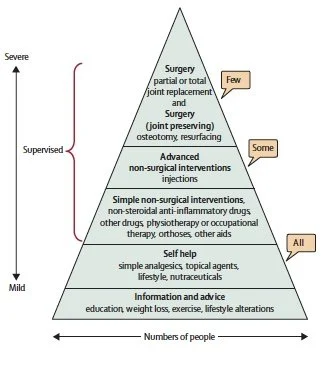
What does ‘conservative care’ mean? Conservative Knee OA care is essentially the lower half of the treatment pyramid. It is essentially anything that does not involve injections or surgery. This course will dwell less on the stuff you put into your body, and more on what you do with it physically (while still recognizing injections / surgery are an important part of knee management when required).
The treatment pyramid is fantastic for giving us a summary of the guidelines - what we should be doing with our osteoarthritis at various points of severity.
However, it still does not give us specifics most of us need for practical management of Knee OA. What exercise for me? What lifestyle alterations? Which drugs? What braces? This are the types of questions our combination of in-clinic care and this online course (along with your physicians) help you to answer - practical advice you can start right now.
The Knee OA Treatment Pyramid - the Guidelines in a Visual Snapshot
The guidelines are great, but the challenge is that there are multiple sets of them from various organizations, they are extensive, and they are often hard to read due to some of the medical jargon involved. Most people are do not have the time or desire to try to sort through them.
That is where the Osteoarthritis Treatment Pyramid can come in. This is an extremely useful visual created by Researchers Dieppe and Lohmander produced a great diagram that helps our understanding of how osteoarthritis should be treated, given its severity.
The OA Treatment Pyramid: Originally Created by Dieppe Lohmander. Credit for Visual Re-creation to Dr. Gillian Hatfield of the University of the Fraser Valley
The pyramid shape is used to represent the total population of those with osteoarthritis. The lower half of the pyramid represents people having mild to moderate osteoarthritis, and the upper half representing more moderate to severe disease.
By far the majority of the folks with knee OA are in the lower part of the pyramid and will primarily be treated with conservative measures (no surgery, no injections.) Those with mild knee OA might not require any formal treatment, but rather just advice and education. In fact, you might be one of those and hopefuly this website is giving you the information you need by reviewing all of the 4 pillars of knee OA care.
But then there are also those in the upper half of the pyramid. Those people should definitely still implement the lower half recommendations (exercise, weight loss, self and professional treatment, etc) but they may also require specialist care with injections and possibly even surgery.
But the Pyramid still needs some ‘meat on the bones’ . . .
. At this point it is important to realize, that this course is dealing with ‘conservative’ knee osteoarthritis care, and to understand what that means.
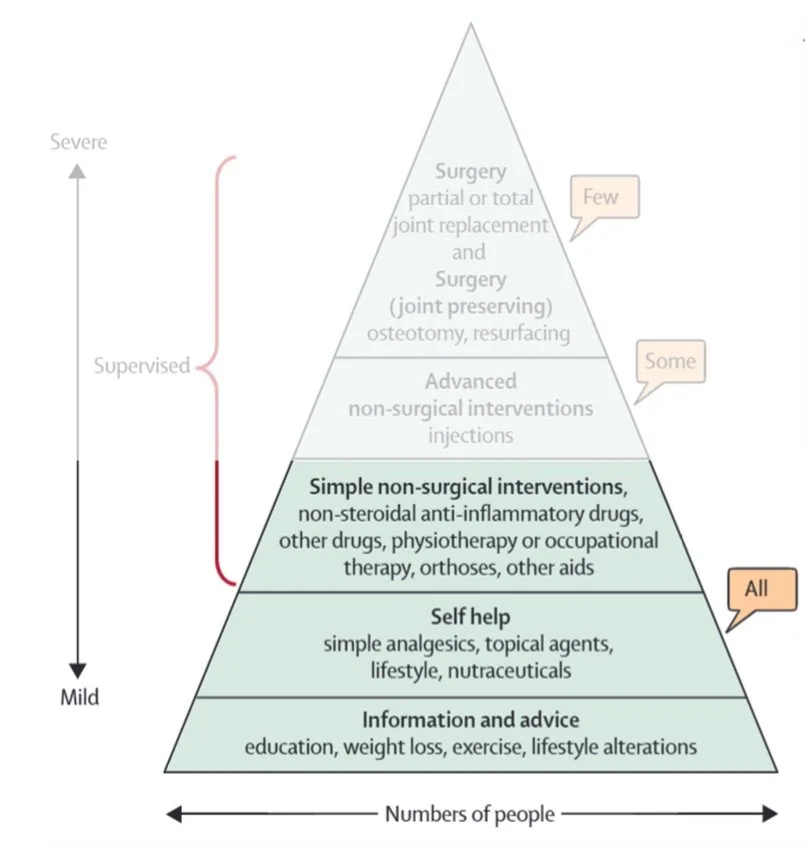
Giving the Pyramid substance and making it memorable . . .
To help put the meat on the bones and make Knee OA management simple, we’ve created the 4 pillars of Knee OA Care to serve as a memorable guide for your journey with Knee OA. All of the recommendations can be fit under the umbrella of each category.