Plantar Fasciitis
Quick Links:
Plantar Fasciitis - Quick Info
What is Plantar Fasciitis?
Plantar fasciitis is an inflammation and/or degeneration of a thick band of tissue that runs along the arch of your feet from your heel to your toes and aids in stabilization of your arch while you walk and run.

What is the Plantar Fascia?
The plantar fascia is a dense, fibrous connective tissue intricately attached to the heel, toes, and many of the surrounding muscles and structures on the sole of the foot
Plantar Fasciitis vs. Plantar Fasciosis
What is usually called “plantar fasciitis” (which simply means that the plantar fascia is inflamed) is actually plantar fasciosis: (degeneration of the fascia) in most cases. Plantar fasciitis, however, has become the term commonly known to most people so we will use the terms interchangeably.
Guideline-Based Treatment for Plantar Fasciitis
The British Journal of Sports Medicine (BJSM) offers trusted guidelines for treating Plantar Fasciitis in its guide, “Management of Plantar Heel Pain.” This is recommended by many experts as the gold standard to follow.
The BJSM guidelines recommend a stepwise approach to treatment based on how long you've had the condition. There are essential treatments everyone should start with, and additional treatments to consider if symptoms last despite the core approach. This page provides a simple reference for following these guidelines effectively.
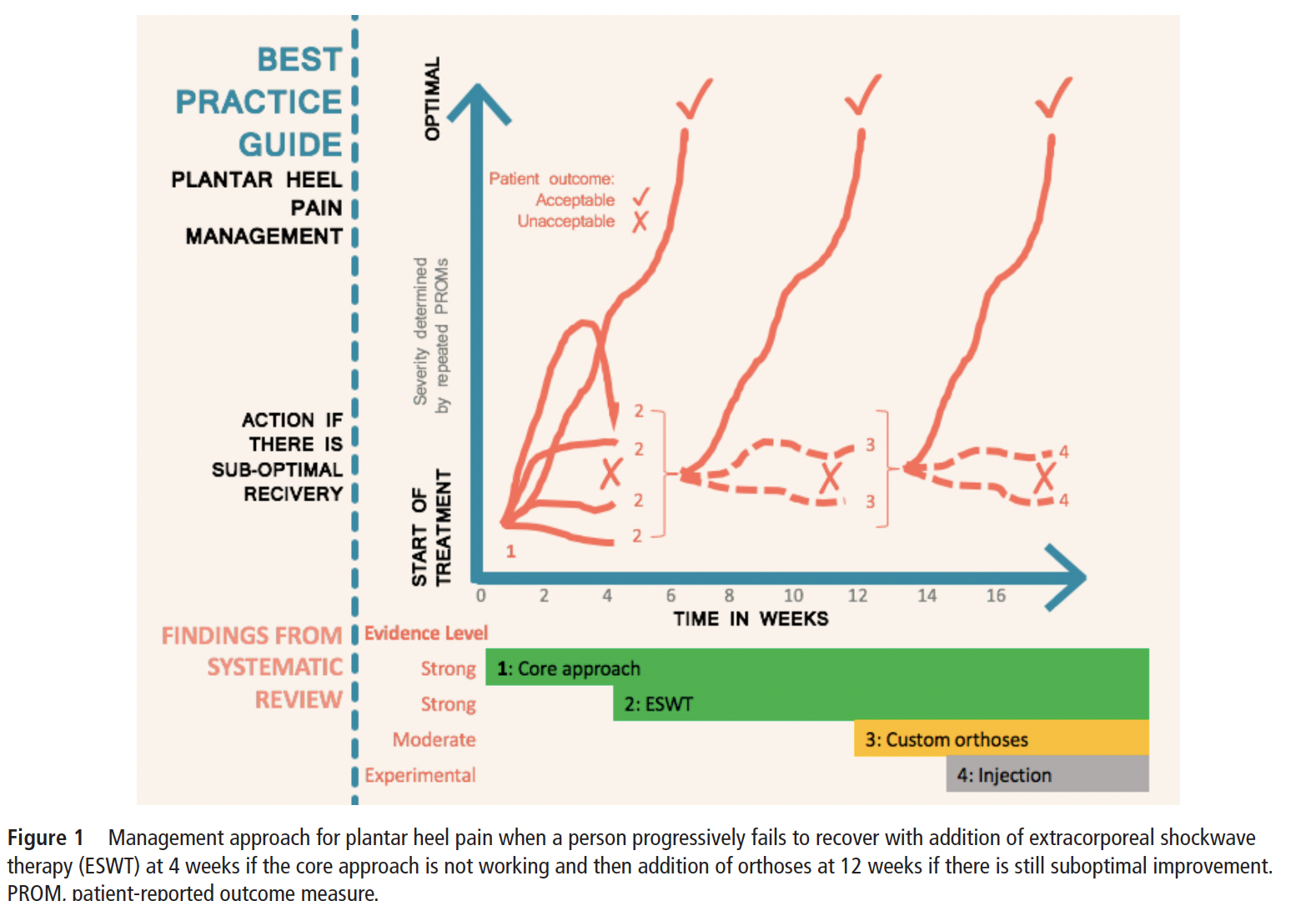
Treatment Phase 1: Core Treatments
Core Treatments for plantar fasciitis are those that are safe and recommended for nearly everybody experiencing pain in the heel.
Core Treatments include:
Proper Footwear
Some shoes will reduce force on the plantar fascia while others can increase it. The best shoe for your foot will vary with your foot type and your activities. We can give your some footwear recommendations from our footwear guide, or you can visit one of our trusted community partners for footwear.
Inside Footwear
Try to avoid going barefoot at all for several weeks. This means getting having some supportive insides shoes or sandals that you can keep on your feet at all times. Keep a pair beside your bed so that you can put them on right away in the morning.
Taping
Taping can be an extremely effective wait to get temporary relief and help you continue your daily activities. We have found the method to the right using leukoplast tape to be one of the most effective and durable methods. Do you use tape if you have any allergies to adhesives and be sure to check the skin. Generally the tape can be kept on for 3-5 days and can be showered with.
Modification of Activities
You will absolutely want to keep you active and maintain your fitness while you work on settling down your heel pain. You will, however, often need to modify activity so you are not pounding so hard on your heel and arch. Consider alternative activities such as swimming and walking. If your condition is worsening over time, it is probably time to decrease your activities.
Weight Loss
Being overweight can dramatically increase force on the heel. Losing weight will almost always help plantar fasciitis heal. However, although this is one of the best things we can do for our heel pain and for our health generally, it is hard to do and it takes time and some help for many patients. If you are ready to start losing weight and need some assistance, talk to us about a referral to one of our community partners.
Off the Shelf Foot Orthotics
Affordable off-the-shelf foot orthotics can provide immediate pain relief. You can quickly assess their effectiveness by trying one. We stock SOLE OTS orthoses, known to help reduce plantar fasciitis pain, and they are heat moldable to fit any arch height. During your clinic appointment, you may trial SOLE OTS orthotics. Other brands are available through our community partners if SOLE isn't comfortable for you.
Exercises to Stimulate Healing and Increase Plantar Fascia Load Capacity
Ideally, you should be assessed by a physiotherapist for a customized exercise program tailored to your particular assessment findings. However, the following 2 exercises have been researched and found to be effective for many people experiencing plantar fasciitis. They are a good starting point for most. Together, they are known as the “Rathleffe Protocol”.
The evidenced-based group Physiotutors does a great job of outlining how to do these exercises. If you have pain with the exercises or difficulty performing them, your physiotherapist can help you find a modified level to start at.
Treatment Phase 2: Extracorporeal Shockwave Therapy
While many will experience improvement and even recovery with Core Treatments alone, some will need to move on to additional healing stimulation and protective measures. The BMSJ guidelines recommend Extracorporeal Shockwave be undertaken if the condition has not improved satisfactorily in 1 month of Core Treatments.
Extra corporal, shockwave therapy involves the application of high-pressure acoustic waves to stimulate cellular healing and pain relieving substances.
Our shockwave machine is manufactured by EMS Dolorclast, a world leader in shockwave technology, and is used most respected and is used according to research backed protocols. You can learn more about shockwave and its effects in this video.
Treatment Phase 3: Custom Foot Orthotics
If after a course of shockwave therapy your condition is still not significantly improved, the guidelines recommend using custom foot orthotics. These may also be recommended earlier in the process if certain biomechanical faults are noted, have a history of recurrent plantar fasciitis, or struggle with your weight.
Many Extended Health Benefit Plans provide coverage for custom orthotics. Call your plans customer service line to determine if you are covered.
Custom orthotics will typically require an assessment and casting (plaster, foam, or laser scan cast). In some cases, we can provide. Many plans will allow FLEX Rehab to make your orthotics for you. Other plans, however, will require you to see a podiatrist, orthotist, or pedorthist - we can refer you to one of our community partners if this is the case. The majority of our custom foot orthotics are made by Paris Orthotics in Vancouver

Treatment Phase 4: Consider Lower Evidence Treatments
Other options have been reported as potentially effective for plantar fasciitis when the above options fail, but the evidence as uncovered by the BJSM Guidelines was insufficient to meet the criteria for recommendation as Best Pratice
Patients who are still unresolved after Step 3 may which to return to the CORE treatment with greater adherence and give the condition more time, or may wish to try other treatments that have yet to show sufficient evidence for clear recommendation to see how these work for them. Discussion this with your healthcare professional is recommended.
Some additional treatments you may try include:
Icing
Historically, icing has always been recommended for plantar fasciitis treatment. It may help your symptoms on a temporary basis and if so, go ahead and use it. However, just know it is unlikely to make your condition better on its own.
Night Splints
Some people will report relief with night splinting. In fact, while the BJSM guidelines do not include night splinting as a core or stepwise treatment, other guidelines do. The lack of clear evidence may be due to the difficulty some have adhering to night splinting - many of us have enough trouble already. without having something stretching our foot. Again, this is the something you could try - at worst you will spend typically less than $100 with no effect. There are several different types of night splint (classic, sock, dorsal). I recommend a classic version such as the Alpha Medical Night Splint.
Calf Stretching
Calf stretching is another historical mainstay of plantar fasciitis treatment. However, it seems less important in the research than the above noted plantar fascia stretch and loading exercise. Having said that, there is no harm in adding it, especially if you feel you have tight calfs, have previous ankle injury, or it has been recommended to you by your physiotherapist. There are many different ways of stretching your calfs, but a pro-tip is to incorporate it into your brushing your teeth routine by placing your foot up on the inside of the bathroom cabinet below your sink, and aim for at least a minute per day on each calf.
Alternatively, you can do these calf stretches at least 1 minute, 2x per day.